Research
Two pilot studies, one problem
Detectors of AI-generated music work well on the examples they were trained on and fail on new ones. I tested this in audio and in symbolic music.
AI Music Detection on Unseen Generators
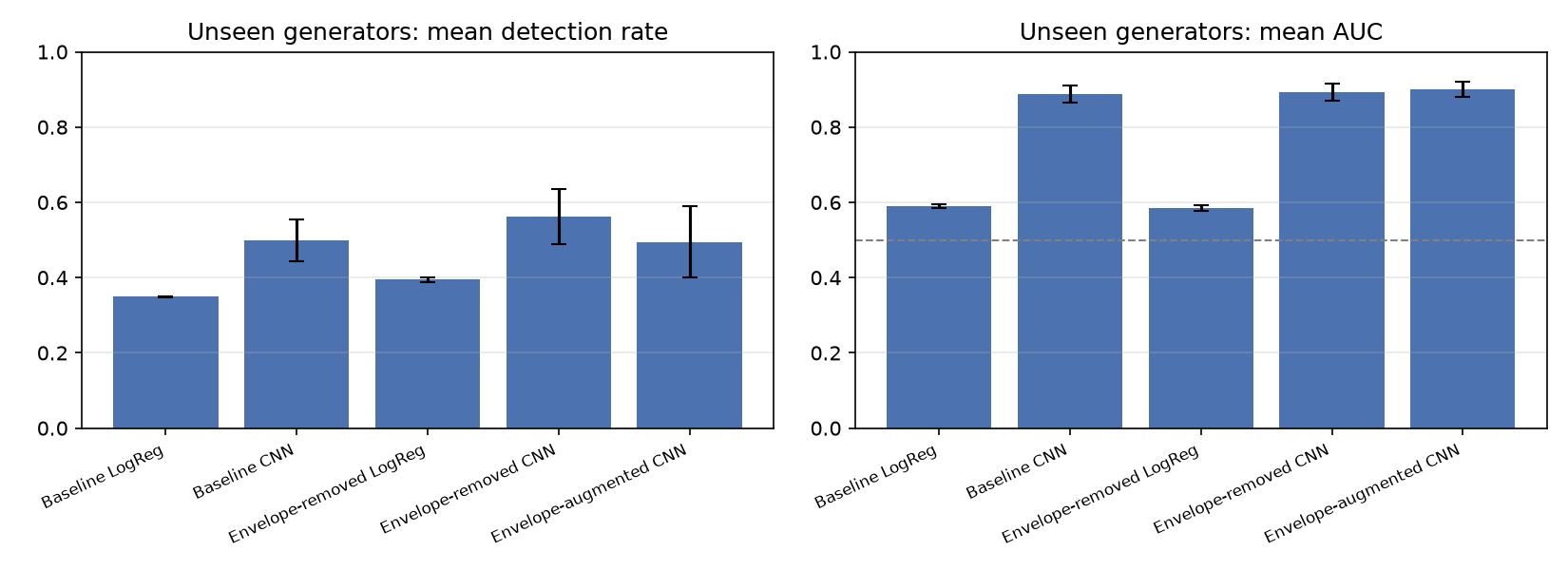
A detector that catches AI music from generators it was trained on catches only about half of the music from a generator it has never seen.
0.975balanced accuracy of the CNN on generators seen in training
0.50share of clips from an unseen generator that it flags as AI
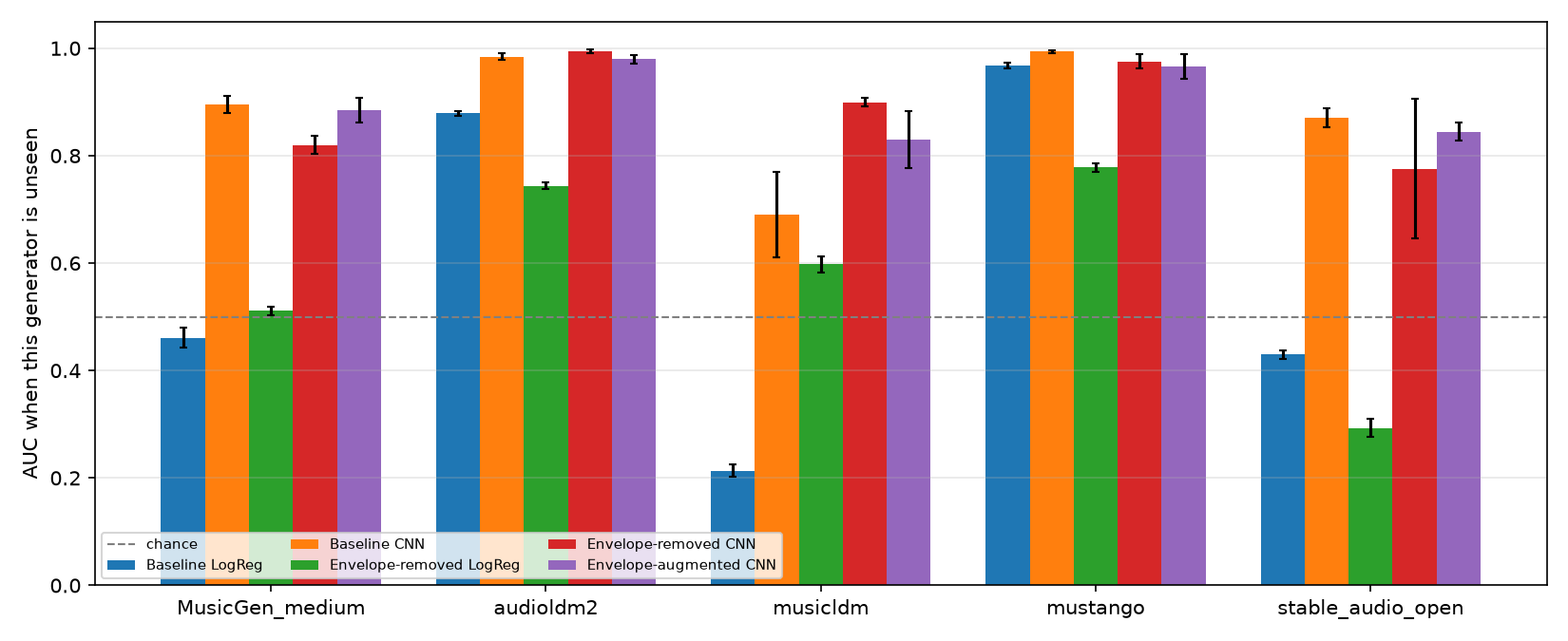
0.21AUC on unseen MusicLDM for a spectral-statistics detector: rated more real than real music
- Data. 2,856 real MusicCaps clips and 27,605 AI clips from five text-to-music models, all 10 s at 16 kHz. Train and test are split by MusicCaps caption, so the same prompt never appears on both sides.
- Test. Each generator is left out of training in turn, then the detector is scored on it. This is the situation a streaming platform faces when a new model is released.
- No single fix. Removing each clip's spectral envelope raises AUC on MusicLDM from 0.69 to 0.90 but lowers it on MusicGen and Stable Audio Open.
- Architecture tracks difficulty. Generators that decode through a mel-spectrogram VAE and HiFi-GAN transfer to each other. MusicGen and Stable Audio Open stay hard (detection 0.18–0.34).
Limits: only 52% of real MusicCaps clips could still be downloaded; real clips are lossy YouTube audio while AI clips are lossless; 3 seeds; five open-source generators.
Testing a Beethoven Classifier on Recombined Imitations
A Beethoven classifier judges each bar on its own, so imitations spliced from real Beethoven bars pass. Looking at how the bars are joined exposes them.
0.96AUC of the reproduced GRU classifier, stable under piece- and year-grouped splits
83–92%of spliced segments classified as Beethoven (real Beethoven: 83%)
0.94–0.96AUC of a transition detector separating spliced from real 32-bar segments
- Reproduction. A two-layer GRU on 27 features per 2-second bar, as in Galajda & Hua (2024). AUC stays at 0.96 when works or recording years are held out.
- Recombination. Splicing bars from different Beethoven works does not lower the score. Splicing even raises it for other composers' music, from 8% to 25%.
- Transitions. A detector that sees only the join between two bars (key change, melodic leap, density jump, held notes) separates spliced segments from real ones.
- The same generalization gap. Trained only on random splices, the detector drops to AUC 0.73 on splices chosen to sound smooth; trained the other way, it drops to 0.56. Smooth splices overshoot: their mean melodic leap is 1.6 semitones, against 9.1 in real Beethoven.